by Reid Scearce

So close, yet so far: Christopher Bell’s seven runner-up finishes mean he’s close to having a breakthrough victory this season
Consistency is the cornerstone of any NASCAR championship campaign, but for Christopher Bell and the No. 20 Joe Gibbs Racing crew, repeatedly finishing second has proven to be a curse that Bell seemingly can’t break, with a 2026 victory remaining an elusive challenge.
Christopher Bell: So Close!
After finishing second at Iowa Speedway last weekend, Bell finds himself in an unusual position: sixth in the point standings, tied for the second-most top fives, and fourth in laps led despite having no wins following his seventh runner-up finish in 23 races. Notably, Iowa was his fourth second-place finish in five races.
To understand the narrative of Bell’s season, one has to examine how each of these seven “so close, yet so far” moments unfolded
Phoenix
Bell’s first runner-up finish came at Phoenix in just the fourth race of the season. Bell was the clear driver to beat, winning Stage Two and leading a race-high 176 laps, but he couldn’t catch Ryan Blaney in the closing stretch after the No. 12 team took only two right-side tires before a late-race restart to gain track position.
Charlotte
Nearly ten races later at Charlotte for the Coca-Cola 600, Christopher Bell arguably had the best long-run speed. He battled with his Toyota teammates throughout the race, leading 44 laps and earning a stage victory. However, with impending rain threatening to end the race early, Daniel Suárez grabbed the lead off pit road by taking two tires. On the ensuing restart, Suárez managed to hold off JGR teammates Bell and Denny Hamlin, who couldn’t clear each other, before a red flag halted the race. A second red flag ultimately ended the race early, making Suárez the victor and Bell the bridesmaid for the second time.
Nashville
The very next week at Nashville, Christopher Bell yet again brought the long-run speed. Bell was the favorite in the closing stages, chasing down and eventually passing Zane Smith for the lead, who was on an alternative-fuel strategy; however, much like Phoenix and Charlotte, a late-race caution set up a restart with four laps to go. Bell lined up side by side with teammate Denny Hamlin, and neither competitor gave an inch before fellow JGR driver Chase Briscoe made it three-wide on the final lap, forcing Bell to defend his line and allowing Hamlin to clear him for the win. Bell once again settled for second, earning back-to-back runner-up finishes.
Chicagoland
A month later at NASCAR’s return to Chicagoland Speedway, Christopher Bell had a car capable of winning. He didn’t find himself in serious contention until the final stage, when he began quickly running down teammate Chase Briscoe in the closing laps following green-flag pit stops. With one lap to go, Bell managed to reach Briscoe’s bumper, but Briscoe remained disciplined, expertly blocking and crossing the finish line with Bell behind him in second once again.
Atlanta
A week later at EchoPark Speedway, Bell was competitive all day, but he, along with everybody else, had nothing for Ryan Blaney, who swept the stages and led a dominant 171 laps. On the final turn following an overtime restart, Bell found himself behind the front three cars, including Blaney. Knowing how strong the No. 12 car was, Bell opted to push Blaney, helping secure him the win, while momentum on the high side carried Bell across the finish line in third. However, he was ultimately scored second after Bubba Wallace, the driver ahead of him, was penalized for going below the double-yellow line on the back straightaway.
Unlike the previous four races, this finish was not heartbreaking for the Joe Gibbs Racing No. 20 Toyota team, with Bell describing the result to TNT Sports reporters as “as good as I was gonna get.”
Indianapolis
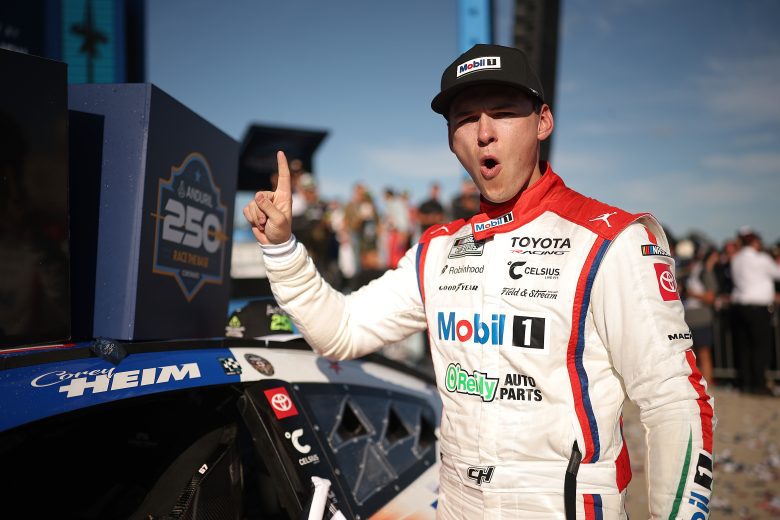
At Indianapolis Motor Speedway, Christopher Bell wasn’t in contention for most of the day despite being the fastest driver in practice. After strategy put him in the top five to start Stage 3, Bell moved up to second following another restart with 34 laps to go. Despite having a better car than race leader Corey Heim, who was running a part-time schedule with 23XI Racing, Bell was unable to make the pass due to the severe limitations of the Next Gen car at a narrow, flat track like Indianapolis.
Bell would come home second, but with his head held high, saying in his post-race media interview, “This is a good second place. We’ve had a lot of bad second-place finishes, but this one is a good one. We were buried after qualifying, and Adam [Stevens] did a great job with strategy to get us up there.”
Iowa
The next race at Iowa Speedway would leave Bell unsatisfied, as he finished runner-up for the fourth time in five races. This time, Bell led 108 laps, recorded the race’s fastest lap, and won Stage 2. However, on the final set of green-flag pit stops, JGR teammate Ty Gibbs, running second, took two tires compared to Bell’s four. Bell quickly caught Gibbs with around 40 laps to go, and it appeared he would make quick work of his teammate. Unfortunately for the No. 20 team, Gibbs masterfully blocked Bell’s runs as the two worked through lap traffic, while Iowa’s difficulty in passing further aided Gibbs’ defense. Gibbs would ultimately come away with the win, while Bell earned, you guessed it: second.
Joe Gibbs Racing Competitive Season
When viewed as a whole, it’s easy to see why these seven runner-up finishes are so intriguing. Rarely was Bell simply not fast enough; more often than not, a combination of Next Gen aerodynamics, late-race pit strategy, or track-position gambles ultimately cost him the win. On three separate occasions, Bell’s team possessed arguably the best long-run car, only for competitors to take two tires during late-race caution periods and steal the lead from him. At places like Chicagoland, Indianapolis, and Iowa, dirty air and well-executed defensive tactics from Briscoe, Heim, Gibbs, and others ultimately sealed the outcome. It’s particularly frustrating for Bell that so many of these wins have been snatched away by his fellow Toyota teammates. Bell’s seven second-place finishes without a victory now tie Harry Gant’s 1981 Cup Series record for the most runner-up finishes in a season before earning a win. While it’s certainly not an ideal position for Bell, the feat speaks volumes about his talent as a competitor and the overall competitiveness of Joe Gibbs Racing’s program.
Fine Tuning Needed to Win
It’s very likely the No. 20 team is prioritizing the end of their unlucky streak and finally getting to Victory Lane. However, it’s time that Bell and crew chief Adam Stevens make tactical changes when handling late-race scenarios. In the Next Gen era, dirty air heavily favors the leader. Emphasizing immediate track position over general long-run pace—such as gambling on a two-tire strategy to control the front row on a final restart—may need to take precedence. Bell will also have to be willing to risk it all on late-race restarts, taking whatever lane is available to put himself in clean air and avoid getting trapped behind slower cars ahead.
Still, the good news for the No. 20 team is that these adjustments are more about fine-tuning than fixing a major problem. Bell’s driving, combined with the performance of his pit crew and his ability to consistently collect stage points, has the team right where it needs to be as a legitimate championship contender. They technically don’t even need a victory to ultimately claim the Cup Series championship. Nonetheless, earning a win would be a massive shot of momentum for Christopher Bell and could quite possibly give the No. 20 team the confidence it needs to make a deep postseason run.