by Reid Scearce

Brickyard 400 racing falls flat despite the NASCAR Cup Series driver Corey Heim’s historic win as a part-time driver for 23XI Racing this season.
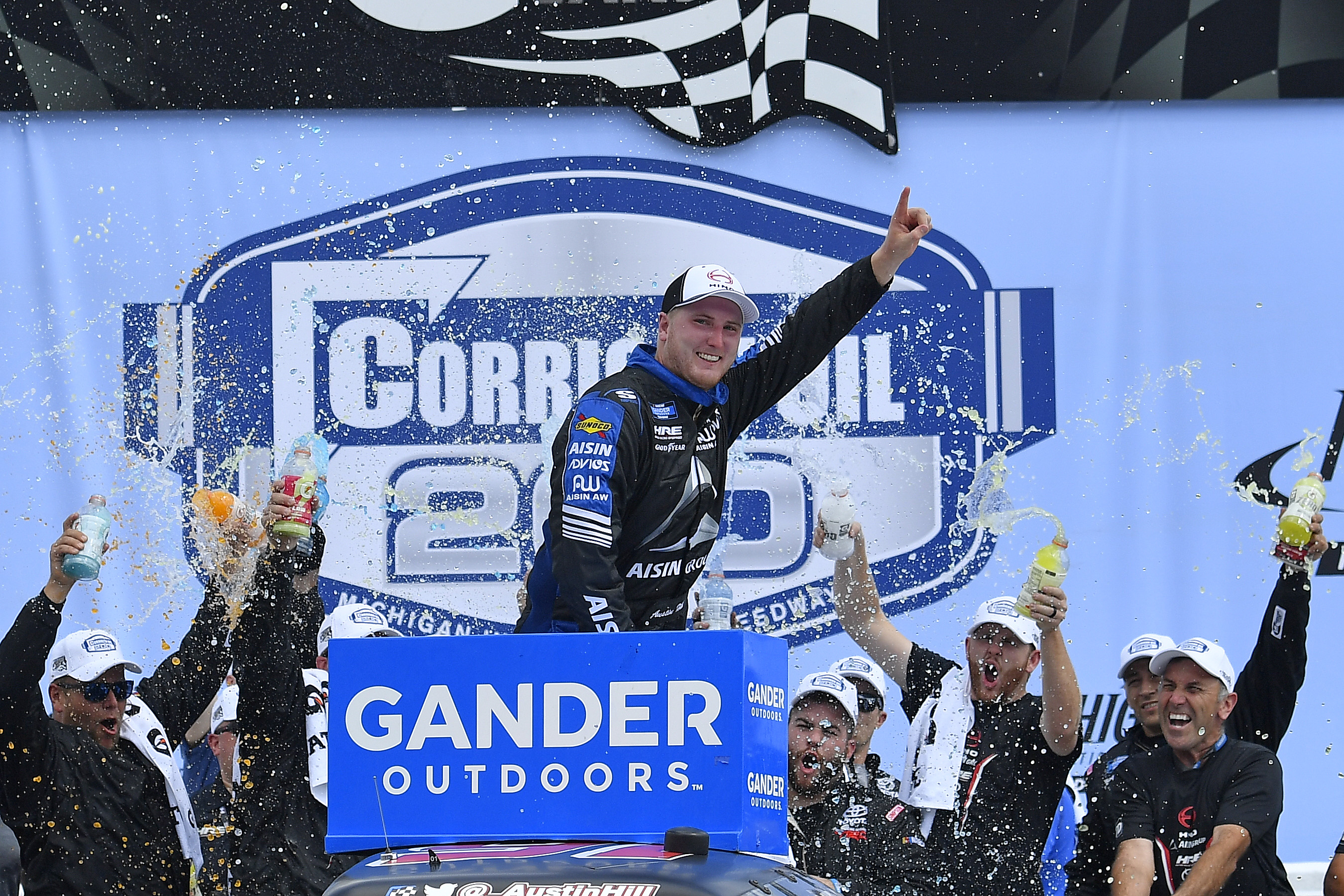
Corey Heim earned the honor of kissing the bricks last Sunday at the historic Indianapolis Motor Speedway. The 24-year-old part-time driver of 23XI Racing’s No. 67 Toyota scored his second win in just 15 career starts. However, scratching beneath the immediate surface is a story of a race dominated by dirty air, track position, and virtually no passing. While Heim’s generational talent is undeniable, the winning car also benefited from the Next Gen car’s aerodynamics on the historic 2.5-mile oval, making passing exceedingly difficult and frustrating drivers and fans alike.
Brickyard 400 Falls Flat
While the venue provided the typical prestige associated with the Brickyard, statistically, the 160-lap crown jewel race was the least competitive and dynamic race of the 2026 NASCAR Cup Series season thus far.
- The race featured only 15 lead changes among 11 drivers. Every one of those lead changes was purely because of pit strategy cycles and restarts. Outside of the stated conditions, not a single pass for the lead occurred under normal green flag conditions.
- Green-flag passes, and total pass metrics at Indianapolis ranked near the bottom among all 22 points-paying Cup races contested thus far in 2026. Many race fans on social media expressed frustration that they could not recall a single green-flag pass anywhere in the field outside of, once again, restarts and pit cycles.
- Track position was paramount, but to a ridiculous degree. Clean air at the front of the field was worth an extreme advantage over cars trying to run in the draft of those ahead. Heim led a race-high 58 laps—including the final 33. According to data from Jayski, Heim’s average lead over Christopher Bell was only 0.25 to 0.35 seconds in the closing laps. Yet he managed to maintain it throughout the entire final stint purely on aero superiority.
Eric Estepp offered a blunt assessment of the racing product during his weekly race recap on his YouTube show Out of the Groove:
“This was the worst racing product I have seen this entire NASCAR Cup Series season, and some of it’s the track—one-lane, flat corners. I don’t think it’s well suited for stock car racing, frankly, but a lot of it, of course, is the Next Gen car, which is abominable in dirty air.”
Driver Assessments
Many of the afternoon’s chasers shared the same gripe regarding the challenge posed by dirty air. Runner-up Christopher Bell, who logged his sixth second-place finish of the season, noted during his post-race interview with TNT Sports that the only way he could have won was if the leader made a major error.
“Honestly, I didn’t think I’d be able to get there at all,” Bell admitted post-race. “My guys were telling me he was going loose and I knew really that…my only opportunity was going to be a mistake from him. I just needed one bobble.”
Third-place finisher Joey Logano, who ran behind Heim and Bell the final run, felt he didn’t have a realistic shot of overtaking the leader without a front-row restart position.
“I was faster than them, but I got three-car lengths back, and that was it. I lost the air. I couldn’t go fast anymore,” said Logano in his post-race interview on pit road. “I needed track position. Track position won the race. You had to be on the front row, and we were one row back.”
The aerodynamic limitations of the package were significant to Sunday’s racing. Nevertheless, that does not take away from the skill it took for Corey Heim to remain out front, especially while running a part-time schedule. The youngest Brickyard 400 winner since Jeff Gordon in 1994, Heim struggled with a loose-handling car as the track surface cooled, forcing him to maintain a line that kept the drivers behind him in turbulent air. After overtaking his car owner, Denny Hamlin, for the lead on the final restart on Lap 127, Heim drove his Toyota Camry for the final 34 consecutive laps with minimal mistakes.
“That was a damn handful,” Heim told reporters at the start-finish line following his victory burnout. “I was hanging on for dear life once the shade went down and the pace picked up. My car got really loose… That was the hardest I’ve ever fought in my life to just make sure I focused on exits and kept them in dirty air.”
The Discussion Continues
While there will undoubtedly be conversations about aero-package tweaks for flat ovals in the future, Corey Heim’s display of race management, with very limited Cup Series seat time, remains truly spectacular. However, NASCAR has an enormous amount of work ahead if the Brickyard 400 is to remain a race that fans genuinely anticipate, rather than one that lingers solely because of its past prestige and history. Objectively, this week’s race was a chore to watch, and no one in the NASCAR industry wants a repeat next year.